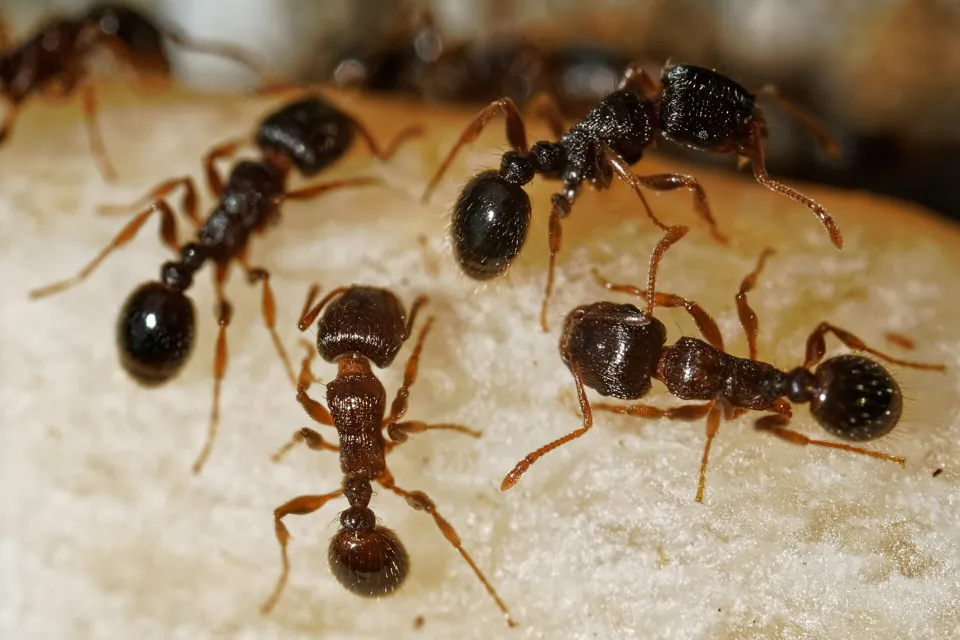
Which ant is it?
Several ant species live around Boise. Three account for most of the questions homeowners and renters ask, and they are fairly easy to tell apart once you know what to look for.
Pavement ants
These are the small, dark brown to blackish ants, roughly an eighth of an inch long, that live under sidewalks, driveways, patio slabs and foundations. Look closely and you may see fine parallel grooves on the head and back. They are the ant most Boise households end up seeing indoors, usually in a line along a baseboard or across a kitchen floor.
Odorous house ants
Slightly smaller and brown to black, odorous house ants move quickly in erratic trails and go straight for sweets: juice spills, fruit, syrup, pet food and sugary recycling. Crush one and you get a sour smell often compared to rotten coconut. That smell is the quickest field test. They favor damp spots, so they often turn up near sinks, dishwashers and leaky fixtures.
Western harvester ants
Larger, reddish ants that build low gravel mounds in dry, open ground. A harvester mound usually sits in the middle of a bare, cleared circle where the ants have removed the plants. They collect seeds rather than raiding kitchens, and they rarely come indoors. They do sting, though, and the sting is painful.
- Most common indoors
- Pavement ants
- Sugar-loving kitchen ant
- Odorous house ant
- Stinging ant outdoors
- Western harvester ant, in dry ground near the foothills
- Busiest season
- Spring through late summer
- Ants indoors in winter
- Usually a nest in or under the heated house
Where and when they show up in Boise
Pavement ants become obvious in spring. On a warm day you may see dense clusters of them on a sidewalk or driveway. These are neighboring colonies fighting over territory, and the brawls can cover a patch of concrete for hours. Around the same time, small piles of fine soil appear along slab edges and in driveway cracks, pushed up from the tunnels below.
Boise's long, dry summer pushes ants indoors in search of water. The airport record shows July and August as the driest months, with only about two tenths of an inch of rain in each. A dripping hose bib, a sweating pipe or a damp cabinet under the sink becomes a target. Odorous house ants are especially drawn to that moisture.
Fall brings another shift. Once irrigation water is shut off and lawns stop being watered, soil near the house dries out. A foundation that holds a bit of warmth and moisture can attract colonies that were content in the yard all summer.
Where you live matters too. Older homes in the North End, the East End and the Bench often have settled foundations, patched slabs and gaps around old plumbing that give ants easy routes in. Newer homes in Harris Ranch, the Barber Valley and along the foothills in Northwest Boise and the Boise Highlands tend to have tighter construction. However, they sit next to open, dry ground where harvester ants can build mounds at the edge of a lot. For more on how conditions differ across the city, see the Boise neighborhoods guide.
Ants in December?
Ants walking across a floor in winter rarely come from the frozen yard. They usually mean a colony is living in or under the heated part of the house. Common spots are beneath a slab warmed by a furnace, water heater or radiant floor heat, or inside a wall void. That is a good time to call a licensed provider, because the nest is protected and active year round.
Signs to look for
A single ant on the counter does not tell you much. Patterns do. Watch for these:
- A steady trail along a baseboard, window sill or the back edge of a countertop
- Little piles of sand or soil along slab joints, garage floors or driveway cracks
- Ants coming up through a crack in a basement or slab floor
- Ants clustered around a sink, dishwasher, pet bowl or recycling bin
- A rotten-coconut smell when an ant is crushed
- A gravel mound inside a bare circle in a dry part of the yard
- Winged ants indoors, which can mean a mature colony is nearby
- Ants active inside during cold months
If you are finding small insects in flour or cereal rather than trailing across surfaces, the culprit may be something else entirely. Our pantry pests guide covers those.
What helps reduce ants
Prevention will not remove an established colony. It can make your home much less attractive, though, and it makes any professional work last longer.
- Take away food. Wipe up crumbs and sticky spills, keep sweets and pet food in sealed containers, and rinse recyclables before they go in the bin.
- Take away water. Fix dripping faucets and leaky hose bibs, and check under sinks for slow leaks. In a dry Boise summer, water often draws ants in more than food does.
- Break the bridges. Trim shrubs and tree branches so they do not touch siding, and keep thick mulch pulled back from the foundation.
- Close the obvious gaps. Seal openings around pipes, cables and utility lines where they enter the house, and repair worn door sweeps.
- Mind the sprinklers. Aim heads away from the foundation so the soil against the house is not soaked all season.
Store-bought sprays can backfire, especially with odorous house ants. Their colonies often have many queens and can split into new colonies when disturbed, which may leave you with more trails rather than fewer. That is one reason a stubborn infestation is worth handing to a professional.
When to call a licensed provider
Consider calling a provider when trails keep coming back after you have cleaned up food and water sources, when ants appear indoors in winter, when you suspect a nest inside a wall or under a slab, or when a harvester mound sits near a play area, dog run or garden path.
A licensed provider will typically do the following:
- Identify the species. Pavement, odorous house and harvester ants respond to different approaches.
- Follow the trails. They track ants back toward the nest, checking slab joints, foundation cracks, plumbing entries and wall voids.
- Choose targeted methods. This often means bait placed where ants will carry it back to the colony and where pets and kids cannot reach it, sometimes paired with focused exterior work.
- Point out conditions. They note leaks, gaps and landscaping that are inviting ants in.
- Follow up. A second visit confirms that activity has dropped, since colony-level results take time.
In Idaho, pesticide applicators are licensed through the Idaho State Department of Agriculture, and it is reasonable to ask to see that license. Our guide to choosing a pest control company lists other questions worth asking. To see how ant activity fits with other pests through the year, check the seasonal pest calendar.
Harvester ants sting
Keep children and pets away from harvester mounds, and do not stir up a mound to see what is inside. Stings are painful and can swell. Anyone with signs of a serious reaction, such as trouble breathing or swelling of the face or throat, needs prompt medical care.
Boise ant questions
What are the ants piled up on my sidewalk every spring?
Almost always pavement ants. Neighboring colonies fight over territory on warm spring days, and the clusters can look alarming. The fight itself is harmless to you. It does show that colonies are nesting under the concrete near your house.
Why do I have ants inside in the middle of winter?
Outdoor colonies slow down in Boise's cold months. Steady winter activity usually points to a nest inside the heated structure, often under a slab or in a wall near warmth and moisture. A licensed provider can help find it.
Are the red ants near the foothills dangerous?
Western harvester ants can deliver a painful sting, so treat their mounds with respect. They are most common in dry, open ground near the foothills edge. Keep kids and pets clear of the bare circle around the mound, and have a provider assess mounds that sit in high-traffic parts of a yard.
My older North End house has ants every summer. Why?
Older homes often have settled foundations, patched floors and gaps around aging plumbing that ants use as doorways. Add dry summer heat sending ants looking for water, and a kitchen or bathroom becomes a regular stop. Fixing leaks and sealing entry points helps. A recurring problem usually needs the nest addressed.
How can I tell an odorous house ant from a pavement ant?
The smell test is the easiest. Odorous house ants give off a rotten-coconut odor when crushed, while pavement ants do not. Odorous house ants also move in faster, more erratic trails and gravitate to sweets and damp areas.