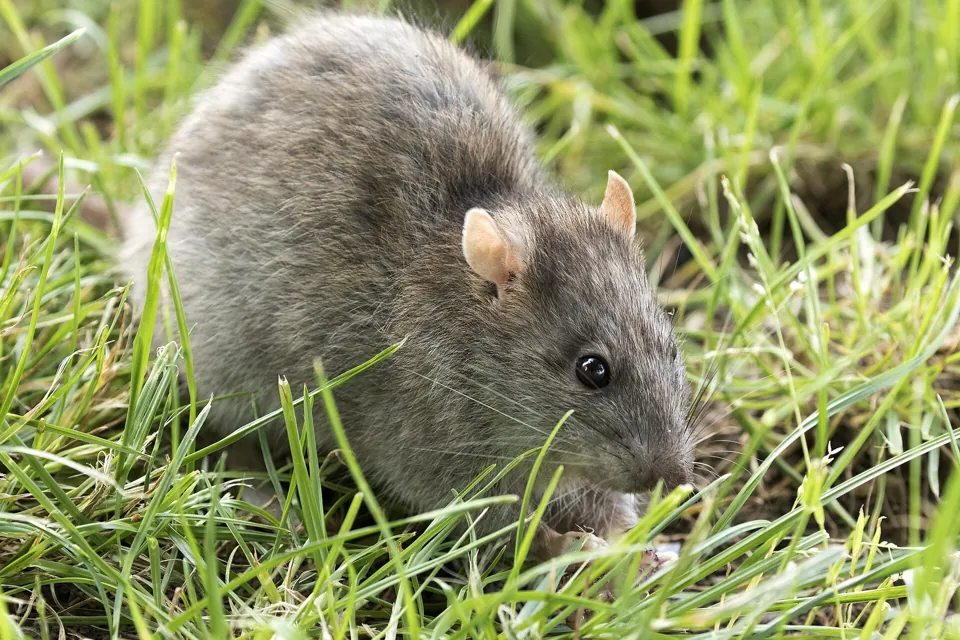
Telling a Norway rat from a mouse or vole
The Norway rat, also called the brown rat, is the species Treasure Valley homeowners usually run into. It is a heavy-bodied burrower with coarse brown or grayish fur, a paler belly, a blunt nose and small ears that sit close to the head. Its scaly tail is noticeably shorter than its head and body together.
The most common mix-up is with house mice and deer mice, which also move toward buildings in fall. A young rat can be mouse-sized, but its head and feet look oversized for its body. Mice have large ears, pointed faces and slim tails. If you mostly see small droppings in a pantry drawer, the mice guide is likely the better fit.
- Common species
- Norway (brown) rat
- Adult size
- Roughly 7 to 10 inches of body, plus a shorter tail
- Shelter
- Burrows in soil, under slabs, sheds, decks and woodpiles
- Most noticed
- Fall into winter, though active all year
- Breeding
- Year-round when food and shelter allow; litters often 6 to 12
- Entry gap
- An opening about the size of a quarter can be enough
Where Boise rats live and when they move in
Norway rats need three things close together: soil they can dig in, water, and steady food. Boise supplies all three along its waterways. Irrigation canals and laterals such as the Ridenbaugh Canal and the New York Canal give them soft banks for burrows, and the cottonwood-lined Boise River and Greenbelt corridor offers cover from one end of the city to the other.
From there, rats follow food into yards. The places that tend to draw them in Boise include:
- Backyard chickens. Spilled feed, stored grain and coop bedding are hard for rats to pass up, and the ground under a coop is easy digging.
- Bird feeders. Seed scattered on the ground below feeds rats as reliably as it feeds finches.
- Compost and pet food. Open bins and bowls left on a patio overnight are common draws.
- Fruit trees. Older lots in the North End, the East End and parts of the Bench often have apple, pear or plum trees, and dropped fruit can feed rats for weeks in late summer and fall.
- Sheds, decks and woodpiles. Low structures with a gap underneath give rats a dry, hidden place to burrow near food.
Timing matters too. Water runs in the canals through the growing season and is shut off in fall. Around the same time, gardens are finished, nights turn cold, and rats that spent summer outdoors often look for warmer, steadier shelter. That is when many Boise households first hear scratching in a garage, crawlspace or wall. Southwest Boise properties with acre lots, pasture or animals can see activity any time of year.
Reported rat activity around Boise
The map below shows community reports of rat sightings collected by the Treasure Valley Pied Piper map. Each dot is something a resident chose to report, placed at an approximate location. Dots cluster where people are looking and reporting, so a busy area does not mean a particular street is at higher risk, and an empty area does not mean rats are absent. Use it as a general picture, not a measure of your own block.
Reported rat activity from the Treasure Valley Pied Piper community map, centered on Boise. Points are approximate.
Signs of rats, and staying safe around them
Rats are mostly active at night and wary of people, so many households find the evidence before they ever see the animal. Look for:
- Burrows about 2 to 4 inches across, often along a fence line, a foundation, under a shed or deck, beside a coop or on a canal-side slope, with loose dirt fanned out at the opening.
- Runways, packed paths worn through grass or mulch along walls and fences.
- Grease marks, dark smudges where oily fur rubs repeatedly along a sill, beam or gap.
- Droppings that are capsule-shaped, blunt at the ends and roughly three-quarters of an inch long, near feed, bins or along walls.
- Gnawed fruit on the tree or ground, hollowed squash, or chewed feed bags and bin lids.
- Noise at night: scratching, scurrying or gnawing in the garage, attic, crawlspace or walls.
Avoid touching droppings or nests
Rodent droppings, urine and nesting material can carry disease. Public health guidance from the CDC and Central District Health is to avoid sweeping or vacuuming droppings, which can put particles in the air. Instead, air out the space, wear gloves, wet the area with a disinfectant or bleach solution, wipe it up and wash your hands afterward. Keep children and pets away from the area, and call your doctor if anyone becomes ill after contact.
What helps make a Boise yard less inviting
Rats stay where food and shelter are easy. Taking away either one tends to make a property less attractive, especially when neighbors along the same canal or alley do the same.
- Store chicken feed, birdseed and pet food in sealed metal containers, and pick up spilled feed under coops and feeders.
- Bring pet bowls in at night and keep trash and compost in bins with tight lids.
- Collect dropped fruit regularly in late summer and fall rather than letting it sit.
- Stack firewood off the ground and away from the house, and clear clutter from beside sheds and fences.
- Trim shrubs and vines back from siding so the foundation stays visible.
- Fix dripping hose bibs and leaks that offer water during Boise’s dry July and August.
- Look for gaps around garage doors, utility lines and foundation vents, and have them sealed.
These steps reduce the draw but rarely clear an established burrow system on their own.
When to call a licensed provider, and what they do
Consider professional help if you see fresh burrows that reopen after you fill them, signs inside the living space, droppings in more than one area, or rats in daylight, which can suggest a larger population. Activity near a coop, a crawlspace or a child’s play area is also a good reason to call.
Companies that apply pest control products for hire in Idaho are licensed through the Idaho State Department of Agriculture. A typical visit includes:
- Inspection. Walking the yard, foundation, garage and crawlspace to find burrows, runways, entry points and food sources.
- Exclusion. Recommending or sealing gaps with rodent-resistant materials so rats cannot get back inside.
- Control. Setting traps or tamper-resistant bait stations, placed to be family and pet safe and kept away from chickens and wildlife.
- Follow-up. Return visits to check stations, remove captures and confirm activity has dropped.
For help comparing companies, see how to choose a pest control company in Idaho.
Boise rat questions
We live near a canal. Should we expect rats?
Not necessarily, but canal banks give rats good digging and cover, so homes along them benefit from keeping feed, fruit and compost secured. Watch for burrows along the back fence, especially after the fall water shut-off.
Do backyard chickens attract rats?
They can. The draw is usually the feed rather than the birds, so sealed feed storage, cleaning up spills and a coop that sits on a solid or wired base all help.
Why did we start hearing noises in the walls this fall?
Cooler nights, finished gardens and the end of canal irrigation often push rodents toward buildings in fall. Rats and mice can both make noise, so look for droppings to tell which one you have.
Is it a rat or a mouse in my North End house?
Older homes have more gaps, so both are possible. Rat droppings are about three-quarters of an inch long; mouse droppings are closer to rice-grain size. Rats also leave grease marks and larger gnaw holes.
Should I take down my bird feeder?
If you have rat activity, pausing the feeder or using a seed tray to catch spills can make a real difference. Many households resume once activity stops.