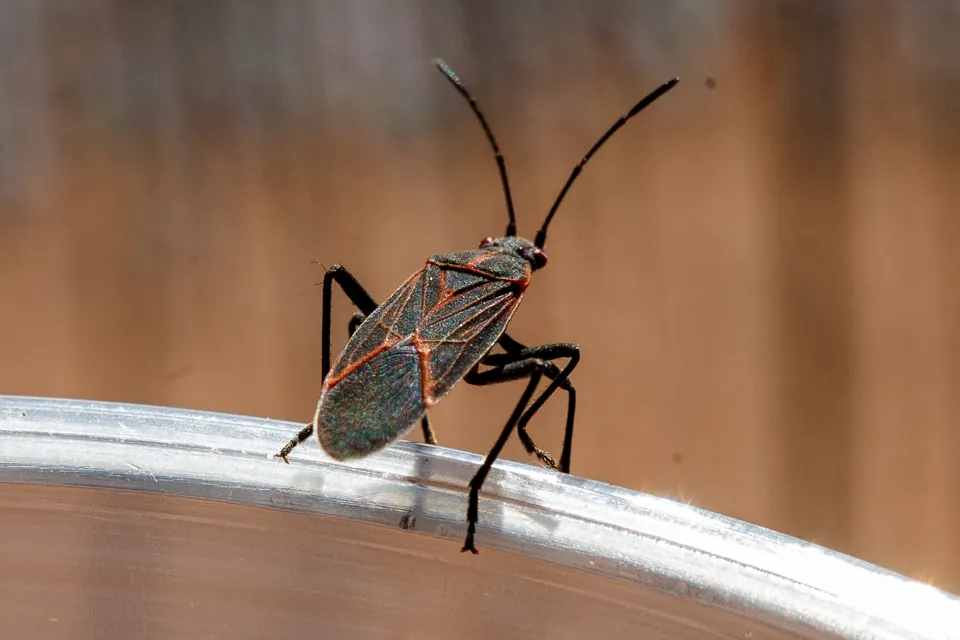
Identifying the boxelder bug Boise actually has
The species most Boise households meet is the western boxelder bug, Boisea rubrolineata. Adults are roughly half an inch long, flat across the back, and dark gray to nearly black. Thin red lines trace the edges of the wings and the area just behind the head. Their eastern cousin looks similar, but in the Treasure Valley, the western bug is the one gathering on your house.
The young, called nymphs, look like a different insect. They are smaller, wingless and bright red, and they darken as they grow. In late summer you can often see nymphs and adults mixed together on tree trunks and the ground beneath them.
Boxelder bugs feed mainly on the seeds of boxelder trees, especially the seed-bearing female trees. They also feed on maple seeds and sometimes on other plants. In a city nicknamed for its trees, many yards are close enough to a food source.
- Common species
- Western boxelder bug (Boisea rubrolineata)
- Size and color
- About half an inch; dark gray with red edging. Nymphs are bright red
- Food
- Mostly boxelder and maple seeds
- Peak visibility
- Late summer through fall, with stragglers on warm winter and spring days
- Risk level
- Nuisance only. No structural damage, but they can stain
When and where they show up in Boise homes
For most of the year, boxelder bugs stay outdoors on host trees. Boise's long, hot summers suit them. The valley's official weather station records about 55 days a year at 90°F or above, and a warm season gives the bugs time to build their numbers.
The shift comes as nights cool in fall. Adults start looking for a protected place to spend the winter. Before they move in, they often bask in the afternoon sun on south and west walls, which hold heat late into the day. Light-colored siding, stucco, brick and sunny window frames can draw hundreds at a time, especially when boxelder or maple trees grow nearby.
From those warm walls, the bugs search for gaps. They work into siding seams, around window and door frames, along rooflines and through vents. Many end up in wall voids and attics, where they sit mostly still through the winter.
Two patterns often confuse people. First, a sunny winter afternoon can warm a wall enough to wake a few bugs, which then wander into living space because the heated house feels like spring. Second, in spring the survivors try to get back outside, and some take a wrong turn indoors. Neither means a new batch has hatched inside. The bugs do not breed in your walls over winter.
No part of town is immune. Tree-lined streets in the North End and East End, older lots on the Bench, and newer homes in Harris Ranch beside the foothills can all see heavy fall gatherings. Exposure and nearby trees matter more than neighborhood. The seasonal pest calendar shows how they fit alongside fall movers such as mice.
Signs you have boxelder bugs
These bugs are rarely subtle. Most people notice them all at once on a warm fall afternoon.
- Clusters of black and red bugs on sunny south or west siding, fences, or the trunk of a boxelder or maple
- Bugs crawling along window frames, sills or the eaves in fall
- Slow, sluggish bugs appearing in upstairs rooms, near ceiling lights or on windows during winter
- A second wave indoors in early spring as overwintering bugs try to leave
- Small reddish or dark spots on curtains, walls or window screens where bugs have rested
- A sharp, unpleasant smell when one is crushed
Easy on the crushing
Boxelder bugs do not chew wood or wiring, and they do not infest food. The main indoor damage is cosmetic. Their droppings can leave spots, and crushing one on fabric, drapes or light paint can leave a stain that is hard to remove.
What helps reduce them
Since the bugs come in from outside, the most lasting help is fewer ways in. Timing matters too. Work done in late summer, before the bugs start massing, pays off more than work done once they are already in the walls.
- Close gaps on the sunny sides. Pay closest attention to south and west walls. Look at siding joints, gaps where pipes and cables enter, and spaces around window and door trim.
- Keep screens in good repair. Torn window screens, loose screen frames and uncovered attic or soffit vents are common entry points.
- Check door sweeps and weatherstripping. Daylight showing under an exterior door is enough of an opening for a flat bug.
- Mind the yard. Raking up fallen boxelder seeds can mean less food close to the house. Trimming plants back from siding also removes shaded resting spots near walls.
- Think about the trees. Seed-bearing boxelders feed the most bugs. Remember, though, that the insects fly in from neighboring lots too, so removing one tree rarely solves the problem alone.
Older homes, including many in the North End and around Warm Springs Avenue, often have more settled trim and aging window frames. Sealing those gaps usually takes more patience there than on a newer build.
When to call a licensed provider, and what they typically do
A handful of bugs on the siding is just part of fall in Boise. It can make sense to bring in a professional in these cases:
- Large numbers return to the same walls every year despite repairs.
- Bugs keep turning up inside through winter and spring.
- The house is tall or hard to reach, which makes sealing upper gaps impractical.
- You are not sure whether you are seeing boxelder bugs or something else.
A licensed provider usually starts by confirming the species and walking the outside of the home. They note which walls the bugs favor and where they are getting in. Many recommend timing exterior work for late summer or early fall, before the bugs move into wall voids. They may also point out gaps, vents or screens worth fixing. In Idaho, people who apply pesticides commercially must be licensed through the Idaho State Department of Agriculture. Asking to see that license is reasonable.
For questions to ask before hiring anyone, see how to choose a pest control company in Idaho.
Boise questions about boxelder bugs
Why does the same wall of my Boise house get covered every fall?
South and west walls collect the most afternoon sun, and boxelder bugs are drawn to that stored heat as nights cool. If a boxelder or maple stands nearby, that wall becomes the obvious gathering spot. The pattern tends to repeat year after year until the gaps on that side are closed.
It's January. Why are boxelder bugs crawling on my windows?
Boise winters bring bright, milder afternoons between cold snaps. A sunny day can warm a wall void or attic enough to wake a few overwintering bugs, and they drift toward light and warmth indoors. They are bugs that moved in during fall, not a new generation.
Are they a risk to kids or pets?
No meaningful risk. Boxelder bugs are not considered a health concern. In rare cases one may poke at skin, but it is not a bite of concern. The bigger worry is stained drapes or carpet from crushed bugs.
Should I remove the boxelder tree in my yard?
Removing a seed-bearing female tree can reduce the food supply right next to your house. Still, bugs travel from trees on other lots, and many Boise streets are well shaded with trees. Treat removal as one factor to weigh with an arborist, not a sure fix.
Do they harm gardens near the Boise River or in the foothills?
Their main food is tree seeds. They occasionally feed on fruit or other plants, which can leave small blemishes, but serious garden damage is uncommon. Homes near the river corridor or the foothills edge are not more at risk from them than others.
Wondering how other pests show up in your part of town? Browse the Boise neighborhoods guide or the general FAQ.