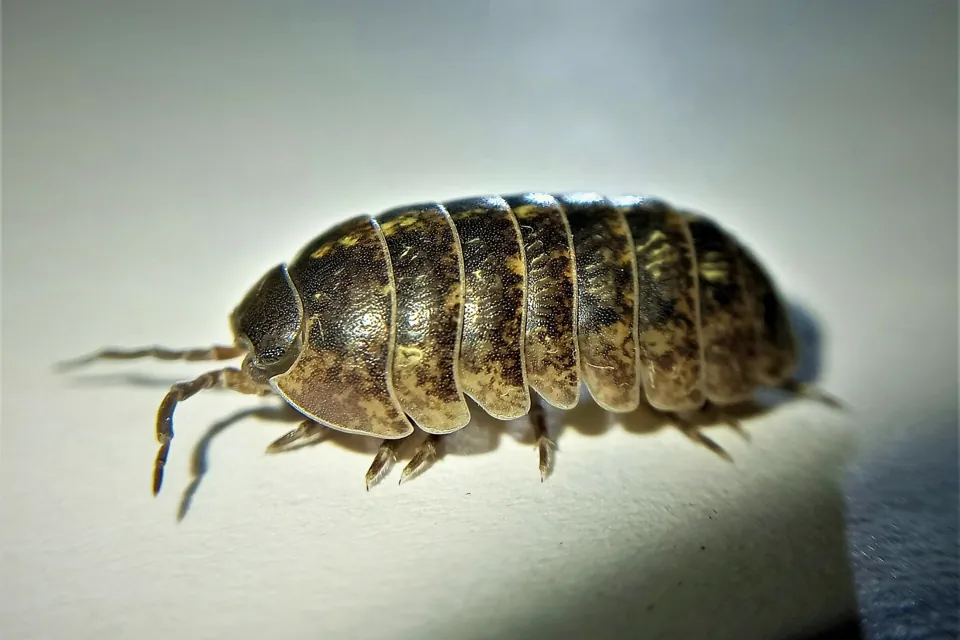
Telling them apart
Millipedes and pill bugs often turn up in the same places, and people tend to mention them together, but they are not close relatives. Both feed mainly on decaying plant material: dead leaves, soft mulch, rotting wood and the thatch layer under turf. Outdoors they do useful work breaking that material down. Indoors they are a nuisance and nothing more.
Pill bugs and sow bugs
These are land-dwelling crustaceans, closer kin to shrimp than to insects. The common pill bug, Armadillidium vulgare, is the gray, armored one that rolls into a tight ball when touched, which is why kids call them roly-polies. Sow bugs look similar but are flatter, have two small tail-like points at the back, and cannot roll up. Both breathe through gill-like structures that must stay moist, so they lose water quickly in dry air.
Millipedes
Millipedes are long, slow and segmented, usually brown to nearly black, with two pairs of short legs on most body segments. When disturbed they often coil into a flat spiral. Some kinds give off a defensive fluid with a strong smell that can stain skin or surfaces. They do not bite or sting. Centipedes, by contrast, are fast, have one pair of longer legs per segment, and hunt other small animals.
- Diet
- Decaying leaves, mulch, damp wood and plant debris
- Peak indoor sightings
- Spring rains and fall
- Where indoors
- Basements, garages, ground-floor rooms near doors
- Health risk
- Harmless to people and pets; they do not bite
- Main driver
- Moisture against the foundation
Why they show up in Boise homes
Boise sits in a high-desert valley. The airport record shows about 11.5 inches of precipitation a year, and July and August are the driest months. On paper, that is poor country for animals that dry out easily. In practice, watered lawns, flower beds and shade trees create pockets of steady dampness, and that is where millipedes and pill bugs settle in.
The most common setup is a sprinkler head that throws water against the siding or foundation every evening. Add a thick bed of bark mulch or a layer of fallen leaves along the wall, and the soil there can stay cool and wet all summer. Populations can build quietly in that strip, right next to the gaps under doors and around sill plates.
Sightings indoors usually come when something changes outside:
- Spring rains. Most of the valley's precipitation falls from late fall through spring. Soaked soil can push them up and out, and some end up in garages and basements.
- Fall. Millipedes in particular are known to move in numbers in autumn. In Boise this lines up with cooling nights and with canal irrigation shutting off for the season, which changes how wet many yards stay.
- Heat waves. In midsummer, they may move toward the cooler, damper concrete of a basement or slab.
Older homes in the North End and on the Bench often have basements and window wells, which collect leaves and hold moisture and give these animals a direct path to a basement window. Newer homes in places like Harris Ranch can see them too, especially where landscaping is young, mulch is deep, and sprinklers run often. Larger lots in Southwest Boise, some near pasture, offer plenty of damp ground at the edges.
Signs you are dealing with them
These animals do not hide well indoors, so the signs are mostly the animals themselves.
- Several curled, dried-up bodies along a basement wall or garage edge in the morning
- Live pill bugs or sow bugs under doormats, potted plants or boxes stored on concrete
- Millipedes on the inside of window wells or on basement window sills
- Clusters near a door threshold after a rainy night
- Large numbers under mulch, stones or leaf piles right against the foundation
- A damp, musty patch of wall or floor where they keep appearing
Dead ones are part of the pattern
Finding many dead millipedes or pill bugs indoors does not mean they are breeding inside. Most homes are too dry for them, so they wander in, dry out and die within a few days. The source is almost always the damp soil and mulch outside, which is why steady sightings point back to moisture near the foundation.
If they appear in one room year after year, that spot is worth a closer look for a leak, a poorly draining downspout, or a window well that stays wet.
What helps: managing moisture
Because these animals depend so heavily on damp conditions, moisture is the lever that matters most. None of the steps below involve treatments; they are ordinary yard and house upkeep that makes the foundation zone less inviting.
- Aim sprinklers away from the house. Overspray onto siding and foundations keeps the soil there wet. Adjusting heads so water lands on lawn and beds, not walls, is often the biggest single change.
- Water in the morning, not the evening. Watering early lets surfaces dry during Boise's hot, dry days instead of staying wet overnight.
- Thin the mulch near the wall. Keeping thick bark or leaf layers pulled back from the foundation leaves a drier strip right where they would gather.
- Clear window wells. Leaves and debris in wells hold moisture. Covers can help keep them out.
- Direct downspouts outward. Water from the roof should move away from the house, not pool at the foundation.
- Fix leaks and dampness inside. A dripping hose bib, a leaky basement pipe or a damp crawl space gives wanderers a reason to linger.
- Tighten the gaps. Worn door sweeps, garage door seals and gaps at the sill plate are common entry points.
- Lift stored items off garage floors. Cardboard and stacked items on concrete hold moisture and shelter them.
For other moisture-loving and fall-wandering pests, see the guides to crickets and spiders, or check the seasonal pest calendar.
When to call a licensed provider
A few millipedes in the garage after a storm do not need professional help. It can make sense to call when sightings are steady over weeks, when large numbers keep turning up in finished basement rooms, or when you have made yard changes and the problem has not eased.
A licensed provider typically starts by walking the outside of the house. They look at where sprinklers hit, how deep mulch sits against the walls, how downspouts and grading drain, and where gaps around doors and windows let animals in. Much of the value is in that assessment, since the right fix is often a change in watering or landscaping.
Where activity is heavy, a provider may also apply a targeted treatment around the foundation under their Idaho pesticide applicator license and the product label. Ask them to explain what they plan to use, where, and how to keep children and pets clear of treated areas while it dries. Our guide to choosing a pest control company in Idaho covers what to ask before you agree to service.
Boise questions about millipedes and pill bugs
Boise is so dry. Why do I have moisture pests at all?
The valley is dry, but irrigated yards are not. Lawns, beds and sprinkler overspray create damp strips along foundations, and that is the habitat these animals need. Natural rainfall is low in summer, so where they live in your yard usually tracks where the water goes.
Why do I see more of them in fall?
Millipedes in particular tend to move in larger numbers in autumn. In Boise this falls around the time canal irrigation shuts off and nights cool down, so yard conditions shift. Some of those wanderers find a gap under the garage door.
Are they a problem for my vegetable garden?
They feed mostly on decaying plant matter, though pill bugs and sow bugs can nibble seedlings or ripe fruit resting on damp soil. University of Idaho Extension in Ada County is a good place to ask about garden-specific concerns.
Can they hurt my kids or pets?
No. They do not bite or sting. Some millipedes release a smelly fluid that can stain or mildly irritate skin, so washing hands after handling them is sensible.
Our North End house has old window wells. Are those the issue?
They can be. Window wells catch leaves from mature street trees and hold moisture, and they sit right against basement windows. Keeping them clear and dry often reduces how many end up inside.