The spiders you are most likely to meet
Boise sits in a high-desert valley, and its spiders suit dry ground, rock and the sheltered gaps around houses. A handful of species account for nearly every call and question.
- Medically important here
- Western black widow only
- Brown recluse
- Not established in Idaho
- Peak indoor sightings
- Late summer through fall
- Favorite hiding spots
- Window wells, garages, basements, woodpiles
- Web clue
- Tangled and messy for widows, flat funnels for house spiders
Western black widow
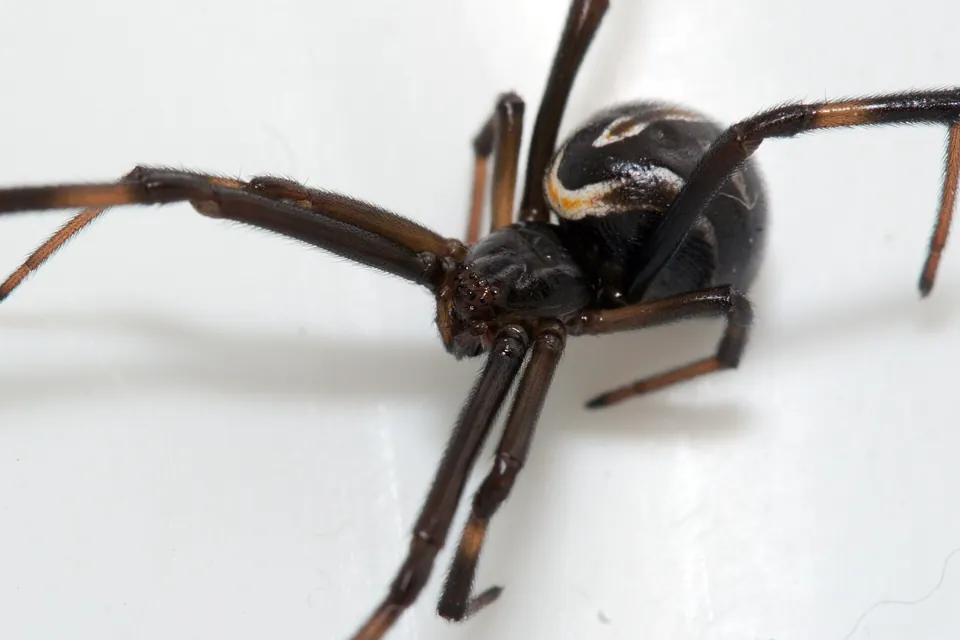
Adult females are glossy black with a round abdomen and a red hourglass on the underside. Younger females, like the one in the photo above, often show tan, white or reddish stripes that fade as they mature. Males are small, lighter in color and rarely noticed. The web looks like a sticky tangle, usually low to the ground, with very strong silk that crackles when you brush it. Widows avoid people, and bites usually happen when a hand presses one against skin, such as reaching into a glove or under a stored box.
Hobo spider and giant house spider
These brown, long-legged funnel-web spiders are easy to confuse, and identifying them for certain often takes a microscope. Their sheet webs narrow to a funnel tucked into rock walls, ground cover and woodpiles. The hobo spider was once described as a serious medical concern. Current University of Idaho Extension guidance does not consider it dangerous in that way, and the older claims have not held up.
Wolf spiders
Hairy, fast and often startling, wolf spiders hunt on the ground rather than in webs. Females carry their egg sac, and later their young, on their bodies. They wander in from lawns and landscape rock and are harmless to people.
Cellar spiders and orb weavers
Cellar spiders have tiny bodies, very long thin legs and loose webs in basement corners and crawlspaces. Orb weavers, including the large garden spiders that turn up in late summer, spin the classic wheel-shaped web between shrubs, fences and eaves. Both are nuisances at most.
Where and when they show up in Boise
The airport record shows July and August as Boise's driest months, with about two-tenths of an inch of rain each, and roughly 55 days a year reach 90°F. Spiders that need shelter from that heat settle into shaded, still spaces: window wells, the gaps behind block walls, garage shelving, the underside of patio furniture and the bottom rows of a woodpile.
Black widows are a familiar find where yards meet sagebrush and rock, which describes much of the North End's upper streets, the Boise Highlands, Northwest Boise along the foothills and Harris Ranch in the Barber Valley. They also turn up well away from the hills, anywhere clutter stays undisturbed. Older homes with basement window wells, common on parts of the Bench and in the North End, give them ideal corners.
From late summer into fall, male hobo and giant house spiders leave their webs to search for mates. That is when many people find a large brown spider in the bathtub, crossing a basement floor or in the garage. These are wanderers, not a sign that a nest has taken over the house. In late summer, orb weaver webs also become hard to miss in gardens and along fences, especially near the river and Greenbelt corridor, where insects are plentiful.
Fall brings another shift. After canal and lateral water is shut off for the season, yards dry and cool, and some insects and the spiders that feed on them can move closer to foundations. Our seasonal pest calendar shows how this overlaps with crickets and other fall arrivals.
Signs worth paying attention to
A single spider in September is ordinary. Patterns are what matter:
- Messy, tough webs low in window wells, under decks or behind stored items in the garage
- Round, papery egg sacs, tan or off-white, tucked into those webs
- Funnel webs in rock walls, ivy or ground cover against the foundation
- Large brown spiders trapped in tubs or sinks during late summer and fall
- Heavy webbing around porch and garage lights, where insects gather at night
- Repeated sightings of glossy black spiders with red markings anywhere children or pets play
If you also notice crickets or other insects indoors, spiders may be following the food. The crickets guide covers that side of the picture.
What helps keep numbers down
Spiders follow shelter and insects. Reducing both makes a home less attractive without any treatment at all.
- Clear clutter in garages and basements. Sealed plastic bins hold up better than cardboard boxes stacked against walls.
- Move woodpiles and stored lumber away from siding and off the ground where you can.
- Trim shrubs and ground cover back from the foundation so the wall stays open and dry.
- Cover window wells and keep leaves and debris out of them.
- Check door sweeps, weatherstripping and screens, especially on garage entry doors and basement windows.
- Rethink outdoor lighting. Fewer insects at the door means fewer spiders waiting for them.
- Wear gloves when reaching into stored items, woodpiles or garden debris, and shake out shoes and work gloves kept in the garage.
Leave the orb weavers be, when you can
Garden orb weavers do not come indoors to settle, and they catch a lot of insects in late summer. Unless a web blocks a doorway, most Boise gardeners simply let them finish the season.
When to call a licensed provider
Consider professional help if you keep finding black widows near living areas, play spaces or entry doors, if spiders are showing up in large numbers indoors, or if you simply cannot tell what you are looking at and want a clear answer.
A licensed provider typically starts by identifying the species, then inspects the places spiders favor: window wells, crawlspaces, garages, eaves and the foundation line. The visit often includes removing webs and egg sacs, pointing out entry gaps and clutter that keep the problem going, and applying targeted treatments outside and in specific cracks and voids rather than across open rooms. Many also look at the insects drawing spiders in. Ask how products are applied and what family and pet safe precautions they follow.
Pesticide applicators in Idaho are licensed through the Idaho State Department of Agriculture. Our guide to choosing a pest control company in Idaho covers what to ask, and it explains Boise's rules for door-to-door sellers.
About bites
See a health-care provider for any wound that worries you, especially one that spreads, worsens or comes with fever. Black widow bites can cause pain that spreads, along with muscle cramping, and deserve prompt medical attention. Many skin sores blamed on spiders turn out to be other conditions, including infections, so an accurate diagnosis matters.
Boise spider questions
Do brown recluse spiders live in Boise?
No. University of Idaho Extension notes the brown recluse is not established in Idaho. A rare one might arrive in shipped goods, but the brown spiders found in Boise basements are almost always house spiders, wolf spiders or similar species.
Is the hobo spider dangerous?
Not in the way it was once described. Current extension guidance does not treat the hobo spider as medically important. Any bite can become irritated, but the black widow is the only spider in Idaho considered a real medical concern.
Why do I see so many big spiders in September?
Male house spiders roam in late summer and fall looking for mates, and they end up in tubs, basements and garages along the way. Sightings often drop off as the season cools.
We live near the foothills. Should we expect more black widows?
Homes bordering rocky, brushy open ground often see them more, but widows also live in tidy neighborhoods across the city. Checking window wells, block walls and stored items is worthwhile anywhere in Boise. Our Boise neighborhoods page covers local patterns.
Are the big webs along the Greenbelt and in my garden a problem?
Usually not. Those are typically orb weavers, which peak in late summer near water and plants. They seldom move indoors and pose no real risk to people.